Combined
Heat and Moisture Transfer (HAMT) Model[LINK]
The combined heat and moisture transfer finite (HAMT)
solution algorithm is a completely coupled, one-dimensional,
finite element, heat and moisture transfer model simulating
the movement and storage of heat and moisture in surfaces
simultaneously from and to both the internal and external
environments. As well as simulating the effects of moisture
buffering, HAMT is also be able to provide temperature and
moisture profiles through composite building walls, and help
to identify surfaces with high surface humidity.
HAMT Nomenclature[LINK]
Dependencies on moisture content are indicated by a
superscript w, on heat by a superscript
h and vapor pressure by a superscript
v.
Combined Heat and Moisture Transfer Model
Nomenclature
| Symbol |
Units |
Meaning |
| T |
°C |
Temperature |
| RH,φ |
%, fraction |
Relative humidity |
| W |
kg/m3 |
Moisture Content |
 |
J/m3C |
Moisture dependent heat storage
capacity |
 |
kg/m3 |
Moisture dependent moisture
storage capacity |
 |
W/mC |
Moisture dependent thermal
conductivity |
 |
J/kg |
Evaporation enthalpy of water (=
2, 489, 000J/kg) |
 |
kg/msPa |
Vapor diffusion coefficient in
air |
 |
- |
Moisture dependent vapor
diffusion resistance factor |
| P |
Pa |
Vapor pressure |
| pambient |
Pa |
Ambient air pressure |
| C |
J/kgC |
Specific heat capacity of dry
material |
| cw |
J/KgC |
Specific heat capacity of water
(=4,180J/kgoC@ 20oC) |
 |
kg/m3 |
Material Density |
 |
kg/m3 |
Density of water (=
1000kg/m3) |
 |
m2/s |
Liquid Transport
Coefficient |
| A |
m2 |
Contact Surface area |
 |
m3 |
Cell Volume |
 |
s |
Time |
 |
s |
Time step between
calculations |
| x |
m |
Distance between cell
centres |
 |
J/C |
Heat Capacitance of cell i |
 |
kg |
Moisture Capacitance of cell
i |
 |
C/W |
Heat Resistance between cells i
and j |
 |
sPa/kg |
Vapor Resistance between cells i
and j |
 |
s/kg |
Liquid Moisture Resistance
between cells i and j |
 |
W |
Heat due to Vaporisation |
 |
W |
Heat from additional
Sources |
| P |
m3/m3 |
Material Porosity |
| p(as a superscript) |
s |
Present Time Step |
| i,j |
- |
Cell indices |
HAMT Model Description[LINK]
Equations and are derived from heat and moisture balance
equations and are taken from [Künzel, H.M. (1995)]. They
describe a theoretical model for the transfer of heat and
moisture through a material.
The three terms in equation describe the storage, transport
and generation of heat respectively.
The three terms in equation describe the storage of
moisture, the transport of liquid moisture and the transport
of vapor respectively. The equation to calculate the vapor
diffusion coefficient in air ( ) used in the third term of both equations, is also taken from
Künzel,
) used in the third term of both equations, is also taken from
Künzel,
The heat storage capacity (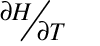 ) depends on the moisture content w of the material by the
following equation.
) depends on the moisture content w of the material by the
following equation.
The moisture content of the material w and the vapor
diffusion resistance factor μ depend on the relative humidity
inside the material. The parameters  ,
,  and
and  are also moisture
dependent parameters.
are also moisture
dependent parameters.
The following sections describe how the above equations are
used within the HAMT model.
Surfaces, Material
Layers and Cells[LINK]
“Surfaces” are made of a number of layers of potentially
any combination of materials. Each surface is split into its
constituent materials and is then split up further into cells
through its depth. HAMT will generate no more than 10 cells
per material with widths that are thinner near the boundaries
of each material where most changes are expected and detail is
needed.
Heat Transfer[LINK]
Equation 1 can be re-written and used to describe the heat
storage and transfer through the ith cell in a
surface.
In the one dimensional case there are only two adjacent
cells each labelled j. The heat generated due to vaporisation
 can be calculated
separately.
can be calculated
separately.
Rearranging equation and including other sources of heat
( ) such as radiation from
other surfaces in the calculation gives the temperature in a
cell in the next time step as,
) such as radiation from
other surfaces in the calculation gives the temperature in a
cell in the next time step as,
where is thermal heat
capacitance of cell i and
is thermal heat
capacitance of cell i and  is
the thermal resistance between cells i and j.
is
the thermal resistance between cells i and j.
This equation can be solved using the Gauss-Seidel
iteration technique. The ith cell temperature is
calculated whilst the jth cell temperatures are
kept as up to date as possible. The iteration is stopped when
the maximum difference between two consecutive calculations in
all cells is less than a threshold of 0.002°C.
Moisture Content w[LINK]
The moisture content (w) of a cell is needed for the
calculation of the heat transfer through the cell as it
affects the thermal resistance and heat capacitance. The
moisture content of cells is calculated from the relative
humidity (RH) of the material. The relationship between w and
the RH for each material is known as the sorption isotherm and
measured data points are entered into EnergyPlus as a series
of coordinates. HAMT interpolates between the measurements to
obtain the moisture content of a material for any RH value.
The sorption isotherm input is via the MaterialProperty:HeatAndMoistureTransfer:SorptionIsotherm
object and is described in the Input Output Reference
document.
The porosity of a material (P) is an input variable and
defined as the maximum fraction, by volume, of a material that
can be taken up with moisture. It is used to calculate the
maximum point on the sorption isotherm curve. The porosity is
entered for each material via the MaterialProperty:HeatAndMoistureTransfer:Settings
object, as described in the Input Output Reference
document.
Moisture
Dependant Thermal Conductivity kw[LINK]
The thermal conductivity (kw) of the cell is
determined by interpolating between data points of thermal
conductivity versus the moisture content of the material,
entered into EnergyPlus via the MaterialProperty:HeatAndMoistureTransfer:ThermalConductivity
object. The moisture content is determined via the sorption
isotherm which gives the moisture content as a function of
Relative Humidity.
Moisture
Dependant Moisture Diffusion Coefficient μ[LINK]
This is used in the third term of equation to describe the
heat transfer due to vapor movement. It is determined by
interpolating between data points of moisture diffusion
coefficient versus the moisture content of the material,
entered into EnergyPlus via the MaterialProperty:HeatAndMoistureTransfer:Diffusion
object. A simple linear interpolation is used to obtain the
conductivity between measured points.
Moisture Transfer[LINK]
Moisture, as well as heat, is transported through materials
as either liquid (w) or vapor (p). There are two different
potentials that control the movement though the material.
Liquid transfer is driven by differences in relative humidity
whereas vapor transfer is driven by differences in vapor
pressure. Materials also have a capacity to store moisture.
Equation can be re-written for a discrete cell in a continuous
material.
Equation can be rearranged to provide the relative humidity
of the ith cell in the next time step.
where 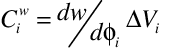 is the “Moisture
Capacitance” of cell i,
is the “Moisture
Capacitance” of cell i,
is the moisture resistance between cells i and j and 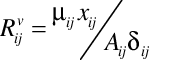 is the vapor resistance between
cells i and j.
is the vapor resistance between
cells i and j.
Equation can be used together with the heat equation in an
alternate step by step fashion to calculate the new
temperature and relative humidity profiles for each cell for
the next time step.
Liquid Transport
Coefficient Dw[LINK]
The Moisture Dependant Liquid Transport Coefficient is
entered as a series of moisture density and liquid transport
coefficient data points. There are two different coefficients,
one for suction, where the surface is wet due to rain, and one
for redistribution where the surface is no longer wet. If the
weather file has a rain flag it is used to switch between
these two types of coefficient. HAMT-SUCTION and
HAMT-REDISTRIBUTION.
This is simply the gradient of moisture sorption isotherm
at the RH of the material.
Convective Heat
Transfer[LINK]
The internal and external heat transfer coefficients are
used to calculate the thermal resistance of the boundary layer
between the zone air and the surface of the surface. They are
either supplied by the user via the advanced surface concepts
object “SurfaceProperty:ConvectionCoefficients” or, if these
are not provided, dynamic values are calculated.
Convective Vapor
Transfer[LINK]
The internal and external vapor transfer coefficients are
used to calculate the resistance to vapour transfer of the
boundary layer between the zone air and the surface of the
surface. They are also either supplied by the user via the
advanced surface concept object SurfaceProperties:VaporCoefficients.
If these are not provided then dynamic values are calculated
based on the convective heat transfer coefficients.
Initial Moisture
Content[LINK]
At the start of an EnergyPlus simulation “warm up” days are
used to ensure that the temperatures of surfaces come to
equilibrium with the environment before the simulation starts
proper. Moisture content within some building fabrics can take
a very long time to come to equilibrium with its environment
and it is therefore necessary to set initial or typical values
of moisture content for each material to be used at the start
of the simulation. These initial values are entered for each
material via the MaterialProperty:HeatAndMoistureTransfer:Settings
object as described in the Input Output Reference
document.
Using the Model[LINK]
As an illustration of the use of the Heat and Moisture
Transfer (HAMT) model, the material properties for a small
sample of six generic materials have been provided in the
EnergyPlus Reference DataSets (MoistureMaterials.idf). The
properties were synthesised from the Annex 24 database [Kumar
Kumaran, M. (1996)], supplemented, when required, by data from
the database of the WUFI model [WUFI (1999)] and are therefore
not related to any unique, measured material. Users should
consult material property catalogues and other primary sources
when the properties of a specific material are required.
Moisture and heat from the surfaces are used by EnergyPlus
to calculate the room air temperature and moisture content.
EnergyPlus with HAMT works best with as short a time step as
possible. However the optimum time step which gives a good
prediction for a short computing time will very much depend on
the nature of the weather and type of building. Buildings with
frequent and large changes in internal and external
temperature will need a small time step, maybe even 60 steps
per hour. Slowly evolving temperatures and relative humidity’s
will not require such a short time step and 20, or even 6,
steps per hour may be sufficient.
Künzel, H.M. (1995) Simultaneous Heat and Moisture
Transport in Building
Components. One- and two-dimensional calculation using simple
parameters. IRB Verlag 1995
Holman, J.P. (2002) Heat Transfer, Ninth Edition.
McGraw-Hill
Winterton, R.H.S. (1997) Heat Transfer. (Oxford Chemistry
Primers; 50) Oxford University Press
Kumar Kumaran, M. (1996) IEA ANNEX 24, Final Report, Volume
3
WUFI (1999) version 2.2 Simultaneous Heat and Moisture
Transport in Building
components. Fraunhofer IBP, Holzkirchen, Germany

Combined Heat and Moisture Transfer (HAMT) Model[LINK]
Overview[LINK]
The combined heat and moisture transfer finite (HAMT) solution algorithm is a completely coupled, one-dimensional, finite element, heat and moisture transfer model simulating the movement and storage of heat and moisture in surfaces simultaneously from and to both the internal and external environments. As well as simulating the effects of moisture buffering, HAMT is also be able to provide temperature and moisture profiles through composite building walls, and help to identify surfaces with high surface humidity.
HAMT Nomenclature[LINK]
Dependencies on moisture content are indicated by a superscript w, on heat by a superscript h and vapor pressure by a superscript v.
HAMT Model Description[LINK]
Equations and are derived from heat and moisture balance equations and are taken from [Künzel, H.M. (1995)]. They describe a theoretical model for the transfer of heat and moisture through a material.
The three terms in equation describe the storage, transport and generation of heat respectively.
The three terms in equation describe the storage of moisture, the transport of liquid moisture and the transport of vapor respectively. The equation to calculate the vapor diffusion coefficient in air ( ) used in the third term of both equations, is also taken from
Künzel,
) used in the third term of both equations, is also taken from
Künzel,
The heat storage capacity ( ) depends on the moisture content w of the material by the
following equation.
) depends on the moisture content w of the material by the
following equation.
The moisture content of the material w and the vapor diffusion resistance factor μ depend on the relative humidity inside the material. The parameters ,
,  and
and  are also moisture
dependent parameters.
are also moisture
dependent parameters.
The following sections describe how the above equations are used within the HAMT model.
Surfaces, Material Layers and Cells[LINK]
“Surfaces” are made of a number of layers of potentially any combination of materials. Each surface is split into its constituent materials and is then split up further into cells through its depth. HAMT will generate no more than 10 cells per material with widths that are thinner near the boundaries of each material where most changes are expected and detail is needed.
Heat Transfer[LINK]
Equation 1 can be re-written and used to describe the heat storage and transfer through the ith cell in a surface.
In the one dimensional case there are only two adjacent cells each labelled j. The heat generated due to vaporisation can be calculated
separately.
can be calculated
separately.
Rearranging equation and including other sources of heat ( ) such as radiation from
other surfaces in the calculation gives the temperature in a
cell in the next time step as,
) such as radiation from
other surfaces in the calculation gives the temperature in a
cell in the next time step as,
where is thermal heat
capacitance of cell i and
is thermal heat
capacitance of cell i and  is
the thermal resistance between cells i and j.
is
the thermal resistance between cells i and j.
This equation can be solved using the Gauss-Seidel iteration technique. The ith cell temperature is calculated whilst the jth cell temperatures are kept as up to date as possible. The iteration is stopped when the maximum difference between two consecutive calculations in all cells is less than a threshold of 0.002°C.
Moisture Content w[LINK]
The moisture content (w) of a cell is needed for the calculation of the heat transfer through the cell as it affects the thermal resistance and heat capacitance. The moisture content of cells is calculated from the relative humidity (RH) of the material. The relationship between w and the RH for each material is known as the sorption isotherm and measured data points are entered into EnergyPlus as a series of coordinates. HAMT interpolates between the measurements to obtain the moisture content of a material for any RH value. The sorption isotherm input is via the MaterialProperty:HeatAndMoistureTransfer:SorptionIsotherm object and is described in the Input Output Reference document.
Porosity P[LINK]
The porosity of a material (P) is an input variable and defined as the maximum fraction, by volume, of a material that can be taken up with moisture. It is used to calculate the maximum point on the sorption isotherm curve. The porosity is entered for each material via the MaterialProperty:HeatAndMoistureTransfer:Settings object, as described in the Input Output Reference document.
Moisture Dependant Thermal Conductivity kw[LINK]
The thermal conductivity (kw) of the cell is determined by interpolating between data points of thermal conductivity versus the moisture content of the material, entered into EnergyPlus via the MaterialProperty:HeatAndMoistureTransfer:ThermalConductivity object. The moisture content is determined via the sorption isotherm which gives the moisture content as a function of Relative Humidity.
Moisture Dependant Moisture Diffusion Coefficient μ[LINK]
This is used in the third term of equation to describe the heat transfer due to vapor movement. It is determined by interpolating between data points of moisture diffusion coefficient versus the moisture content of the material, entered into EnergyPlus via the MaterialProperty:HeatAndMoistureTransfer:Diffusion object. A simple linear interpolation is used to obtain the conductivity between measured points.
Moisture Transfer[LINK]
Moisture, as well as heat, is transported through materials as either liquid (w) or vapor (p). There are two different potentials that control the movement though the material. Liquid transfer is driven by differences in relative humidity whereas vapor transfer is driven by differences in vapor pressure. Materials also have a capacity to store moisture. Equation can be re-written for a discrete cell in a continuous material.
Equation can be rearranged to provide the relative humidity of the ith cell in the next time step.
where is the “Moisture
Capacitance” of cell i,
is the “Moisture
Capacitance” of cell i,
is the moisture resistance between cells i and j and is the vapor resistance between
cells i and j.
is the vapor resistance between
cells i and j.
Equation can be used together with the heat equation in an alternate step by step fashion to calculate the new temperature and relative humidity profiles for each cell for the next time step.
Liquid Transport Coefficient Dw[LINK]
The Moisture Dependant Liquid Transport Coefficient is entered as a series of moisture density and liquid transport coefficient data points. There are two different coefficients, one for suction, where the surface is wet due to rain, and one for redistribution where the surface is no longer wet. If the weather file has a rain flag it is used to switch between these two types of coefficient. HAMT-SUCTION and HAMT-REDISTRIBUTION.
Moisture Dependent Moisture Capacity !!! {:error “Image in Header” :alt “” :img “media/image213.png”} !!![LINK]
This is simply the gradient of moisture sorption isotherm at the RH of the material.
Convective Heat Transfer[LINK]
The internal and external heat transfer coefficients are used to calculate the thermal resistance of the boundary layer between the zone air and the surface of the surface. They are either supplied by the user via the advanced surface concepts object “SurfaceProperty:ConvectionCoefficients” or, if these are not provided, dynamic values are calculated.
Convective Vapor Transfer[LINK]
The internal and external vapor transfer coefficients are used to calculate the resistance to vapour transfer of the boundary layer between the zone air and the surface of the surface. They are also either supplied by the user via the advanced surface concept object SurfaceProperties:VaporCoefficients. If these are not provided then dynamic values are calculated based on the convective heat transfer coefficients.
Initial Moisture Content[LINK]
At the start of an EnergyPlus simulation “warm up” days are used to ensure that the temperatures of surfaces come to equilibrium with the environment before the simulation starts proper. Moisture content within some building fabrics can take a very long time to come to equilibrium with its environment and it is therefore necessary to set initial or typical values of moisture content for each material to be used at the start of the simulation. These initial values are entered for each material via the MaterialProperty:HeatAndMoistureTransfer:Settings object as described in the Input Output Reference document.
Using the Model[LINK]
As an illustration of the use of the Heat and Moisture Transfer (HAMT) model, the material properties for a small sample of six generic materials have been provided in the EnergyPlus Reference DataSets (MoistureMaterials.idf). The properties were synthesised from the Annex 24 database [Kumar Kumaran, M. (1996)], supplemented, when required, by data from the database of the WUFI model [WUFI (1999)] and are therefore not related to any unique, measured material. Users should consult material property catalogues and other primary sources when the properties of a specific material are required.
Moisture and heat from the surfaces are used by EnergyPlus to calculate the room air temperature and moisture content. EnergyPlus with HAMT works best with as short a time step as possible. However the optimum time step which gives a good prediction for a short computing time will very much depend on the nature of the weather and type of building. Buildings with frequent and large changes in internal and external temperature will need a small time step, maybe even 60 steps per hour. Slowly evolving temperatures and relative humidity’s will not require such a short time step and 20, or even 6, steps per hour may be sufficient.
References[LINK]
Künzel, H.M. (1995) Simultaneous Heat and Moisture Transport in Building Components. One- and two-dimensional calculation using simple parameters. IRB Verlag 1995
Holman, J.P. (2002) Heat Transfer, Ninth Edition. McGraw-Hill
Winterton, R.H.S. (1997) Heat Transfer. (Oxford Chemistry Primers; 50) Oxford University Press
Kumar Kumaran, M. (1996) IEA ANNEX 24, Final Report, Volume 3
WUFI (1999) version 2.2 Simultaneous Heat and Moisture Transport in Building components. Fraunhofer IBP, Holzkirchen, Germany
Documentation content copyright © 1996-2026 The Board of Trustees of the University of Illinois and the Regents of the University of California through the Ernest Orlando Lawrence Berkeley National Laboratory. All rights reserved. EnergyPlus is a trademark of the US Department of Energy.
This documentation is made available under the EnergyPlus Open Source License v1.0.