Generic
Contaminant Predictor-Corrector[LINK]
The transient air mass balance equation for the change in
zone air generic contaminant concentration may be expressed as
follows:

where:
 = Sum of internal generic
contaminant loads from sources in a zone or interior
surfaces.
= Sum of internal generic
contaminant loads from sources in a zone or interior
surfaces.
The zone air density is used to convert the volumetric rate
of generic contaminant generation from user input into mass
generation rate [kg/s].The coefficient of 106 is
used to make the units of generic contaminant as ppm.
 = Sum of removal rate from
sinks in a zone or interior surfaces [ppm-kg/s]
= Sum of removal rate from
sinks in a zone or interior surfaces [ppm-kg/s]
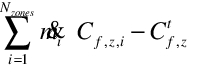 = Generic contaminant
transfer due to interzone air mixing [ppm-kg/s]
= Generic contaminant
transfer due to interzone air mixing [ppm-kg/s]
 = Generic contaminant
concentration in the zone air being transferred into this zone
[ppm]
= Generic contaminant
concentration in the zone air being transferred into this zone
[ppm]
 = Generic contaminant
transfer due to infiltration and ventilation of outdoor air
[ppm-kg/s]
= Generic contaminant
transfer due to infiltration and ventilation of outdoor air
[ppm-kg/s]
 = Generic contaminant
concentration in outdoor air [ppm]
= Generic contaminant
concentration in outdoor air [ppm]
 = Generic contaminant
transfer due to system supply [ppm-kg/s]
= Generic contaminant
transfer due to system supply [ppm-kg/s]
 = Generic contaminant
concentration in the system supply airstream [ppm]
= Generic contaminant
concentration in the system supply airstream [ppm]
 = Air system supply mass
flow rate [kg/s]
= Air system supply mass
flow rate [kg/s]
 = Generic contaminant
storage term in zone air [ppm-kg/s]
= Generic contaminant
storage term in zone air [ppm-kg/s]
 = Zone
air generic contaminant concentration at the current time step
[ppm]
= Zone
air generic contaminant concentration at the current time step
[ppm]
 = Zone
air density [kg/m3]
= Zone
air density [kg/m3]
 = Zone
volume [m3]
= Zone
volume [m3]
 = Generic contaminant
transport through diffusion between interior surfaces and zone
air
= Generic contaminant
transport through diffusion between interior surfaces and zone
air
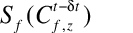 = Generic contaminant
generation or removal rate as a function of zone air generic
contaminant level at the previous time step
= Generic contaminant
generation or removal rate as a function of zone air generic
contaminant level at the previous time step
Mfor = Generic contaminant capacity multiplier
[dimensionless] (See the InputOutput Reference for additional
information on the object
ZoneCapacitanceMultiplier:ResearchSpecial)
In the same manner as described above for zone air
temperature (ref. Basis for the Zone
and Air System Integration), the solution algorithms provided
in the ZoneAirHeatBalanceAlgorithm
object are also applied to the zone air carbon dioxide
calculations.
In order to calculate the derivative term with respect to
time, the first order backward finite difference method,
defined as the EulerMethod in the ZoneAirHeatBalanceAlgorithm
object, may be used:

The zone air generic contaminant concentration update at
the current time step using the EulerMethod may be expressed
as follows:

To preserve the stability of the calculation of the zone
generic contaminant concentration, the third order
differential approximation, derived by a Taylor Series and
used in the calculation of the next time step’s zone air
temperature, is also applied to the zone air carbon dioxide
calculations. This algorithm is the default choice and is
defined as ThirdOrderBackwardDifference in the ZoneAirHeatBalanceAlgorithm
object.
The third order derivative resulting from a Taylor Series
expansion is defined as:

The coefficients of the approximated derivative are very
close to the coefficients of the analogous Adams-Bashforth
algorithm. Then the approximated derivative is substituted
into the mass balance, and the terms with the carbon dioxide
concentration at past time steps are all put on the right-hand
side of the equation. This third order derivative zone carbon
dioxide update increases the number of previous time steps
that are used in calculating the new zone generic contaminant
concentration and decreases the dependence on the most recent.
The higher order derivative approximations have the potential
to allow the use of larger time steps by smoothing transitions
through sudden changes in zone operating conditions.

This gives us the basic air mass balance equation that will
be solved in two different ways, one way for the predict step
and one way for the correct step.
Since the third choice of solution algorithms uses an
integration approach, defined as AnalyticalSolution in the ZoneAirHeatBalanceAlgorithm
object, it does not require any approximations and has no
truncation errors. The solutions in both prediction and
correction are provided below in detail.
Generic Contaminant
Prediction[LINK]
For the generic contaminant concentration prediction case,
the equation is solved for the anticipated system response as
shown below.

Since the program provides three solution algorithms, the
generic contaminant prediction from each solution algorithm is
given below.
For this solution algorithm, the air mass balance for the
predicted air system load or response is:
ThirdOrderBackwardDifference[LINK]
For this solution algorithm, the air mass balance for the
predicted system load or response is given below:
AnalyticalSolution[LINK]
For this solution algorithm, the air mass balance for the
predicted air system load or response is given below:
At the prediction point in the simulation, the system air
mass flows are not known; therefore, the system response is
approximated. The predicted air system generic contaminant
load is then used in the system simulation to achieve the best
results possible. If a central HVAC system provides the
outdoor flow rate from a Controller:MechanicalVentilation
object, the outdoor airflow rate may be approximated as:
where:
 = Supply outdoor airflow
rate into the controlled zone [kg/s]
= Supply outdoor airflow
rate into the controlled zone [kg/s]
The above approximation is based on the assumption that the
generic contaminant concentration at the outdoor air (OA)
mixer inlet is equal to the zone air outlet concentration
level, and the generic contaminant level at the zone supply
air inlet is equal to the level at the outlet node of the OA
mixer.
After the system simulation is completed, the actual
response from the air system is used in the generic
contaminant correction step, which is shown next.
Generic Contaminant
Correction[LINK]
For the correct step, the expanded air mass balance
equation is solved for the final zone generic contaminant
concentration at the current time step. In the same manner as
described above for predicting the carbon dioxide load to be
met by the air system, the zone air carbon dioxide correction
calculation will be described individually for the three
solution algorithms.
ThirdOrderBackwardDifference[LINK]
AnalyticalSolution[LINK]
The above solutions are implemented in the Correct Zone
Air Generic Contaminant step in the Zone
Contaminant Predictor Corrector module of EnergyPlus.

Generic Contaminant Predictor-Corrector[LINK]
The transient air mass balance equation for the change in zone air generic contaminant concentration may be expressed as follows:
where:
The zone air density is used to convert the volumetric rate of generic contaminant generation from user input into mass generation rate [kg/s].The coefficient of 106 is used to make the units of generic contaminant as ppm.
Mfor = Generic contaminant capacity multiplier [dimensionless] (See the InputOutput Reference for additional information on the object ZoneCapacitanceMultiplier:ResearchSpecial)
In the same manner as described above for zone air temperature (ref. Basis for the Zone and Air System Integration), the solution algorithms provided in the ZoneAirHeatBalanceAlgorithm object are also applied to the zone air carbon dioxide calculations.
In order to calculate the derivative term with respect to time, the first order backward finite difference method, defined as the EulerMethod in the ZoneAirHeatBalanceAlgorithm object, may be used:
The zone air generic contaminant concentration update at the current time step using the EulerMethod may be expressed as follows:
To preserve the stability of the calculation of the zone generic contaminant concentration, the third order differential approximation, derived by a Taylor Series and used in the calculation of the next time step’s zone air temperature, is also applied to the zone air carbon dioxide calculations. This algorithm is the default choice and is defined as ThirdOrderBackwardDifference in the ZoneAirHeatBalanceAlgorithm object.
The third order derivative resulting from a Taylor Series expansion is defined as:
The coefficients of the approximated derivative are very close to the coefficients of the analogous Adams-Bashforth algorithm. Then the approximated derivative is substituted into the mass balance, and the terms with the carbon dioxide concentration at past time steps are all put on the right-hand side of the equation. This third order derivative zone carbon dioxide update increases the number of previous time steps that are used in calculating the new zone generic contaminant concentration and decreases the dependence on the most recent. The higher order derivative approximations have the potential to allow the use of larger time steps by smoothing transitions through sudden changes in zone operating conditions.
This gives us the basic air mass balance equation that will be solved in two different ways, one way for the predict step and one way for the correct step.
Since the third choice of solution algorithms uses an integration approach, defined as AnalyticalSolution in the ZoneAirHeatBalanceAlgorithm object, it does not require any approximations and has no truncation errors. The solutions in both prediction and correction are provided below in detail.
Generic Contaminant Prediction[LINK]
For the generic contaminant concentration prediction case, the equation is solved for the anticipated system response as shown below.
Since the program provides three solution algorithms, the generic contaminant prediction from each solution algorithm is given below.
EulerMethod[LINK]
For this solution algorithm, the air mass balance for the predicted air system load or response is:
ThirdOrderBackwardDifference[LINK]
For this solution algorithm, the air mass balance for the predicted system load or response is given below:
AnalyticalSolution[LINK]
For this solution algorithm, the air mass balance for the predicted air system load or response is given below:
At the prediction point in the simulation, the system air mass flows are not known; therefore, the system response is approximated. The predicted air system generic contaminant load is then used in the system simulation to achieve the best results possible. If a central HVAC system provides the outdoor flow rate from a Controller:MechanicalVentilation object, the outdoor airflow rate may be approximated as:
where:
The above approximation is based on the assumption that the generic contaminant concentration at the outdoor air (OA) mixer inlet is equal to the zone air outlet concentration level, and the generic contaminant level at the zone supply air inlet is equal to the level at the outlet node of the OA mixer.
After the system simulation is completed, the actual response from the air system is used in the generic contaminant correction step, which is shown next.
Generic Contaminant Correction[LINK]
For the correct step, the expanded air mass balance equation is solved for the final zone generic contaminant concentration at the current time step. In the same manner as described above for predicting the carbon dioxide load to be met by the air system, the zone air carbon dioxide correction calculation will be described individually for the three solution algorithms.
EulerMethod[LINK]
ThirdOrderBackwardDifference[LINK]
AnalyticalSolution[LINK]
The above solutions are implemented in the Correct Zone Air Generic Contaminant step in the Zone Contaminant Predictor Corrector module of EnergyPlus.
Documentation content copyright © 1996-2026 The Board of Trustees of the University of Illinois and the Regents of the University of California through the Ernest Orlando Lawrence Berkeley National Laboratory. All rights reserved. EnergyPlus is a trademark of the US Department of Energy.
This documentation is made available under the EnergyPlus Open Source License v1.0.