
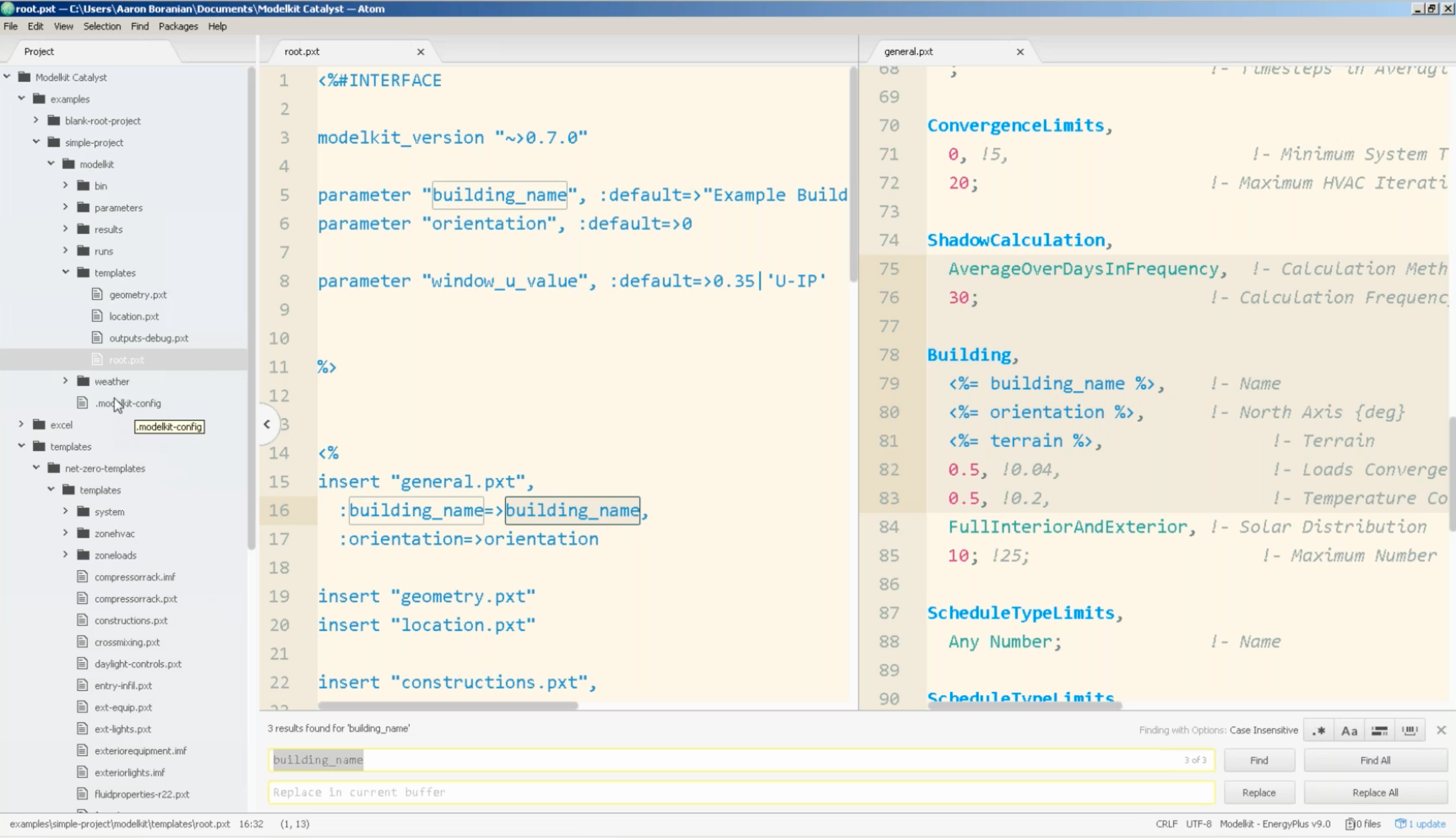
Modelkit / Params software screenshot, courtesy of Big Ladder Software
Key Features
When used with EnergyPlus, Modelkit provides the following major capabilities:Direct EnergyPlus & IDF access
Works directly with native EnergyPlus IDF objects, providing full access to EnergyPlus capabilities without abstraction or limitation.
Flexible, reusable templates
Compose and reuse extensible EnergyPlus templates to accelerate model setup while supporting a wide range of modeling strategies and project requirements.
Built-in energy-efficiency measures
Provides reusable, customizable energy-efficiency measures that can be applied consistently across studies and scenarios.
Readable scripting with Ruby
Built on Ruby with a clear, approachable syntax that supports expressive logic, automation, iteration, and extensibility.
Version control friendly
Designed to work cleanly with version control systems, supporting transparent collaboration, review, and long-term maintainability.
Macro replacement compatibility
Functions as a modern replacement for EPMacro and DOE-2 macros, offering substantially greater flexibility and clarity.
What Modelkit Enables
Instead of manually editing multiple models, Modelkit allows you to define inputs once and automatically generate the variations you need. This approach improves consistency, reduces manual effort, and makes parametric analysis practical for everyday project work.
Modelkit is commonly used for:- Baseline versus proposed comparisons
- Parametric sweeps and sensitivity studies
- Evaluating alternative HVAC systems
- Prototype and research model analysis
- Multi-building or multi-climate studies
How It Works
At its core, Modelkit uses plain-text templates built from standard EnergyPlus IDF objects. These templates are parameterized using Ruby, allowing inputs, logic, and conditional behavior to be defined in a clear and flexible way. Because the templates remain readable text files, they can be modified and extended by modelers without the need for complex APIs or advanced programming knowledge. At the same time, the framework provides full access to the capabilities and detail of EnergyPlus.
Template Library
Modelkit includes a modular library of reusable templates developed and refined through real-world projects. The library supports rapid model assembly while promoting consistency and best practices.
Available template content includes:- Space load configurations
- Zone HVAC equipment
- Central system templates
- Common efficiency measures built directly into the parameters
Supported Tools
Modelkit has been used with several simulation tools, including:- EnergyPlus
- BECC-Com
- CBECC-Res
- California Simulation Engine (CSE)
Why Modelkit
Parametric analysis is at the heart of most energy modeling workflows. Modelkit makes that process faster, more reliable, and easier to manage by combining automation with the transparency and flexibility of text-based models.

