Surface
Heat Balance With Moveable Insulation[LINK]
Basic Heat Balance
Cases[LINK]
A heat balance must exist at the outside surface-air
interface. The incoming conductive, convective, and radiative
fluxes must sum up to zero:
\[Conductive + Convective +
Radiative = 0\]
In contrast to the internal surface heat balance that
treats all surfaces simultaneously, the external thermal
balance for each surface is performed independent of all other
surfaces. This implies that there is no direct interaction
between the individual surfaces.
TARP includes four possible representations for the basic
outside surface heat balance. The first two depend on which of
the optimal surface conductance algorithms the user selects.
The simple outside surface conductance that includes both the
convective and thermal interchange between the surface and the
environment in a single coefficient, is represented by the
thermal network in Figure 29. Equation can also be expressed
as:
\[\left[
{{\rm{KO}}{{\rm{P}}_{\rm{t}}} + {{\rm{Y}}_{\rm{0}}}\cdot
{\rm{T}}{{\rm{I}}_t} - {{\rm{X}}_{\rm{0}}}\cdot
{\rm{T}}{{\rm{O}}_{\rm{t}}}} \right]{\rm{ + }}\left[
{{\rm{HO}}\cdot \left( {{{\rm{T}}_{\rm{a}}} -
{\rm{T}}{{\rm{O}}_t}} \right)} \right]{\rm{ +
QSO = 0}}\]
This can be solved for the outside surface temperature.
\[{\rm{T}}{{\rm{O}}_{\rm{t}}}{\rm{ =
}}\left[ {\frac{{{\rm{KO}}{{\rm{P}}_{\rm{t}}} + {\rm{QSO}} +
{{\rm{Y}}_0}\cdot {\rm{T}}{{\rm{I}}_{\rm{t}}}{\rm{ + HO}}\cdot
{{\rm{T}}_{\rm{a}}}}}{{{{\rm{X}}_{\rm{0}}}{\rm{ + HO}}}}}
\right]{\rm{ }}\]
The detailed outside surface conductance model considers
convection and radiant interchange with the sky and with the
ground as separate factors. Its use in the outside thermal
balance is shown in Figure 30.In this case, equation can be
expanded to give
\[\left[
{{\rm{KO}}{{\rm{P}}_{\rm{t}}}{\rm{ +
}}{{\rm{Y}}_{\rm{0}}}\cdot {\rm{T}}{{\rm{I}}_{\rm{t}}}{\rm{ -
}}{{\rm{X}}_{\rm{0}}}\cdot {\rm{T}}{{\rm{O}}_{\rm{t}}}}
\right]{\rm{ + }}\left[ {{\rm{HA}}\cdot \left(
{{{\rm{T}}_{\rm{a}}}{\rm{ - T}}{{\rm{O}}_{\rm{t}}}}
\right){\rm{ + HS}}\cdot \left( {{{\rm{T}}_{\rm{s}}}{\rm{ -
T}}{{\rm{O}}_{\rm{t}}}} \right){\rm{ + HG}}\cdot \left(
{{{\rm{T}}_{\rm{g}}}{\rm{ - T}}{{\rm{O}}_{\rm{t}}}} \right)}
\right]{\rm{ + QSO = 0 }}\]
This can be solved for the outside surface temperature:
\[{\rm{T}}{{\rm{O}}_{\rm{t}}}{\rm{ =
}}\left[ {\frac{{{\rm{KO}}{{\rm{P}}_{\rm{t}}} + {\rm{QSO}} +
{{\rm{Y}}_0}\cdot {\rm{T}}{{\rm{I}}_{\rm{t}}}{\rm{ + HA}}\cdot
{{\rm{T}}_{\rm{a}}}{\rm{ + HS}}\cdot {{\rm{T}}_{\rm{s}}}{\rm{
+ HG}}\cdot {{\rm{T}}_{\rm{g}}}}}{{{{\rm{X}}_{\rm{0}}}{\rm{ +
HA + HS + HG}}}}} \right]{\rm{ }}\]
The third and fourth representations occur when the outside
surface has been covered with movable insulation. The
insulation has a conductance of UM. The thermal network in
Figure 31 represents this case.The insulation must be
mass-less because it is not generally possible to perform a
correct thermal balance at the juncture of two surfaces each
modeled by CTF.
The equation for the thermal balance between the surface
and the insulation is
\[\left[
{{\rm{KO}}{{\rm{P}}_{\rm{t}}} + {{\rm{Y}}_{\rm{0}}}\cdot
{\rm{T}}{{\rm{I}}_t} - {{\rm{X}}_{\rm{0}}}\cdot
{\rm{T}}{{\rm{O}}_{\rm{t}}} + {\rm{UM}}\cdot \left( {{\rm{TM -
T}}{{\rm{O}}_{\rm{t}}}} \right)} \right]{\rm{ +
QSO = 0}}\]
Which can be rewritten to solve for TO :
\[{\rm{T}}{{\rm{O}}_{\rm{t}}}{\rm{ =
}}\left[ {\frac{{{\rm{KO}}{{\rm{P}}_{\rm{t}}} + {\rm{QSO}} +
{{\rm{Y}}_0}\cdot {\rm{T}}{{\rm{I}}_{\rm{t}}}{\rm{ + UM}}\cdot
{\rm{TM}}}}{{{{\rm{X}}_{\rm{0}}}{\rm{ + UM}}}}}
\right]{\rm{ }}\]
Depending on whether or not the detailed or simple
algorithm for surface conductance is being used, there are two
expressions for TM, the outside temperature of the insulation.
For the simple conductance:
\[{\rm{TM}} = \left[
{\frac{{{\rm{QSM + UM}}\cdot {\rm{T}}{{\rm{O}}_{\rm{t}}}{\rm{
+ HO}}\cdot {{\rm{T}}_{\rm{a}}}}}{{{\rm{UM + HO}}}}}
\right]\]
For the detailed conductance:
\[{\rm{T}}{{\rm{O}}_{\rm{t}}}{\rm{ =
}}\left[ {\frac{{{\rm{QSM}} + {\rm{UM}}\cdot
{\rm{T}}{{\rm{O}}_{\rm{t}}}{\rm{ + HA}}\cdot
{{\rm{T}}_{\rm{a}}}{\rm{ + HS}}\cdot {{\rm{T}}_{\rm{s}}}{\rm{
+ HG}}\cdot {{\rm{T}}_{\rm{g}}}}}{{{\rm{UM + HA + HS + HG}}}}}
\right]{\rm{ }}\]
In this case the values of HA, HS and HG must be found by
using an estimated value of TM in place of TO.
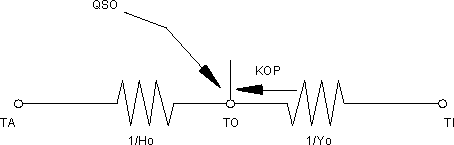
Figure 29. Thermal Network for Simple Outside Surface
Coefficient

Figure 30. Thermal Network for Detailed Outside Surface
Coefficient
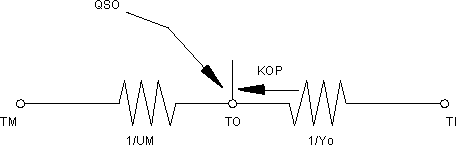
Figure 31. Thermal Network for Outside Moveable
Insulation
Heat Balance Cases[LINK]
TOt and TIt are related through the
Y0 CTF. However TIt is
also unknown. While it is possible to combine the outside and
the inside surface heat balances to compute TOt and
TIt simultaneously, TARP uses a simpler procedure
where TOt is based on a previous value of TI. When
Y0 is small, as occurs in well insulated or very
massive surfaces, TIt can be replaced by
TIt\ -1 (which is known for the previous hour’s
heat balance) without significantly effecting the value of
TOt\ . When Y0 is large, TO and TI can
so strongly be coupled that separate outside and inside heat
balances do not work because the environment and zone
temperatures have negligible influence on the heat balances.
The TARP uses the inside surface heat balance to couple
TOt with TZ and TR. These two temperatures are
less strongly influenced by TO and allow a reasonable heat
balance. On the first heat balance iteration, TZ and TR are
the values at time t-1. The user may optionally require that
TOt be recomputed with every iteration of
TIt \ . In this case TZ and TR have values from
the previous iteration and a true simultaneous solution is
achieved. In most conventional constructions, recomputing
TOt does not significantly change the computed zone
loads and temperatures. The inside surface heat balance is
given by
\[{\rm{T}}{{\rm{I}}_{\rm{t}}} =
\left[ {\frac{{KI{P_t} + QSI + HC\cdot TZ + HR\cdot TR +
{Y_0}\cdot TO}}{{{Z_0} + HC + HR}}} \right]\]
The surface heat balances can be combined in eight ways
according to conditions for calculations of the outside
surface temperature
\[{F_1} = \left[
{\frac{{{Y_0}}}{{{Z_0} + HI + HR}}} \right]\]
\[{F_2} = \left[
{\frac{{UM}}{{UM + HO}}} \right]\]
\[{F_3} = \left[
{\frac{{UM}}{{UM + HA + HS + HG}}} \right]\]
Case1:
Y0 small, simple conductance, no movable
insulation:[LINK]
From Equation
\[{\rm{T}}{{\rm{O}}_{\rm{t}}}{\rm{ =
}}\left[ {\frac{{{\rm{KO}}{{\rm{P}}_{\rm{t}}} + {\rm{QSO}} +
{{\rm{Y}}_0}\cdot {\rm{T}}{{\rm{I}}_{{\rm{t - 1}}}}{\rm{ +
HO}}\cdot {{\rm{T}}_{\rm{a}}}}}{{{{\rm{X}}_{\rm{0}}}{\rm{ +
HO}}}}} \right]{\rm{ }}\]
Case2:
Y0 not small, simple conductance, no movable
insulation:[LINK]
From Equations and
\[{\rm{T}}{{\rm{O}}_{\rm{t}}}{\rm{ =
}}\left[ {\frac{{{\rm{KO}}{{\rm{P}}_{\rm{t}}} + {\rm{QSO}} +
{\rm{HO}}\cdot {{\rm{T}}_{\rm{a}}} + {{\rm{F}}_1}\cdot \left(
{{\rm{KI}}{{\rm{P}}_{\rm{t}}}{\rm{ + QSI + HI}}\cdot {\rm{TZ +
HR}}\cdot {\rm{TR}}} \right)}}{{{{\rm{X}}_{\rm{0}}}{\rm{ + HO
- }}{{\rm{F}}_{\rm{1}}}\cdot {{\rm{Y}}_0}}}}
\right]{\rm{ }}\]
Case3:
Y0 small, detailed conductance, no movable
insulation:[LINK]
From Equation
\[{\rm{T}}{{\rm{O}}_{\rm{t}}}{\rm{ =
}}\left[ {\frac{{{\rm{KO}}{{\rm{P}}_{\rm{t}}} + {\rm{QSO}} +
{{\rm{Y}}_0}\cdot {\rm{T}}{{\rm{I}}_{{\rm{t - 1}}}}{\rm{ +
HA}}\cdot {{\rm{T}}_{\rm{a}}} + {\rm{HS}}\cdot
{{\rm{T}}_{\rm{s}}} + {\rm{HG}}\cdot
{{\rm{T}}_{\rm{g}}}}}{{{{\rm{X}}_{\rm{0}}}{\rm{ + HA + HS +
HG}}}}} \right]{\rm{ }}\]
Case4:
Y0 not small, detailed conductance, no movable
insulation:[LINK]
From Equations and
\[{\rm{T}}{{\rm{O}}_{\rm{t}}}{\rm{ =
}}\left[ {\frac{{{\rm{KO}}{{\rm{P}}_{\rm{t}}} + {\rm{QSO}} +
{\rm{HA}}\cdot {{\rm{T}}_{\rm{a}}} + {\rm{HS}}\cdot
{{\rm{T}}_{\rm{s}}} + {\rm{HG}}\cdot {{\rm{T}}_{\rm{g}}} +
{{\rm{F}}_{\rm{1}}}\cdot \left(
{{\rm{KI}}{{\rm{P}}_{\rm{t}}}{\rm{ + QSI + HI}}\cdot {\rm{TZ +
HR}}\cdot {\rm{TR}}} \right)}}{{{{\rm{X}}_{\rm{0}}}{\rm{ + HA
+ HS + HG - }}{{\rm{F}}_1}\cdot {{\rm{Y}}_0}}}}
\right]{\rm{ }}\]
Case5:
Y0 small, simple conductance, with movable
insulation:[LINK]
From Equations and \(TO_t =
\left[ \frac{ KOP_t + QSO + HA \cdot T_a + HS \cdot T_s + HG
\cdot T_g + F_1 \cdot \left( KIP_t QS1 + HI \cdot TZ + HR
\cdot TR \right) } { X_0 + HA + HS + HG - F_1 \cdot Y_0 }
\right]\)
Case6:
Y0 not small, simple conductance, with movable
insulation:[LINK]
From Equations , and
\[{\rm{T}}{{\rm{O}}_{\rm{t}}}{\rm{ =
}}\left[ {\frac{{{\rm{KO}}{{\rm{P}}_{\rm{t}}} + {\rm{QSO}} +
{{\rm{F}}_2}\cdot \left( {{\rm{QSM + HO}}\cdot
{{\rm{T}}_{\rm{a}}}} \right) + {{\rm{F}}_1}\cdot \left(
{{\rm{KI}}{{\rm{P}}_{\rm{t}}}{\rm{ + QSI + HI}}\cdot {\rm{TZ +
HR}}\cdot {\rm{TR}}} \right)}}{{{{\rm{X}}_{\rm{0}}} + {\rm{UM
- }}{{\rm{F}}_{\rm{2}}}\cdot {\rm{UM -
}}{{\rm{F}}_{\rm{1}}}\cdot {{\rm{Y}}_{\rm{0}}}}}}
\right]{\rm{ }}\]
Case7:
Y0 small, detailed conductance, with movable
insulation:[LINK]
From Equations and
\[{\rm{T}}{{\rm{O}}_{\rm{t}}}{\rm{ =
}}\left[ {\frac{{{\rm{KO}}{{\rm{P}}_{\rm{t}}} + {\rm{QSO}} +
{{\rm{Y}}_0}\cdot {\rm{T}}{{\rm{I}}_{{\rm{t - 1}}}}{\rm{ +
}}{{\rm{F}}_{\rm{3}}}\left( {{\rm{QSM + HA}}\cdot
{{\rm{T}}_{\rm{a}}}{\rm{ + HS}}\cdot {{\rm{T}}_{\rm{s}}}{\rm{
+ HG}}\cdot {{\rm{T}}_{\rm{g}}}}
\right)}}{{{{\rm{X}}_{\rm{0}}}{\rm{ + UM -
}}{{\rm{F}}_{\rm{3}}}\cdot {\rm{UM}}}}}
\right]{\rm{ }}\]
Case8:
Y0 not small, detailed conductance, with movable
insulation:[LINK]
From Equations , and
\[{\rm{T}}{{\rm{O}}_{\rm{t}}}{\rm{ =
}}\left[ {\frac{{{\rm{KO}}{{\rm{P}}_{\rm{t}}} + {\rm{QSO}} +
{{\rm{F}}_1}\cdot \left( {{\rm{KI}}{{\rm{P}}_{\rm{t}}}{\rm{ +
QSI + HI}}\cdot {\rm{TZ + HR}}\cdot {\rm{TR}}} \right){\rm{ +
}}{{\rm{F}}_{\rm{3}}}\left( {{\rm{QSM + HA}}\cdot
{{\rm{T}}_{\rm{a}}}{\rm{ + HS}}\cdot {{\rm{T}}_{\rm{s}}}{\rm{
+ HG}}\cdot {{\rm{T}}_{\rm{g}}}}
\right)}}{{{{\rm{X}}_{\rm{0}}}{\rm{ + UM -
}}{{\rm{F}}_{\rm{3}}}\cdot {\rm{UM -
}}{{\rm{F}}_{\rm{1}}}\cdot {{\rm{Y}}_{\rm{0}}}}}}
\right]{\rm{ }}\]
Fortran Algorithm
Examples[LINK]
Case5:
Y0 small, simple conductance, with movable
insulation:[LINK]
From Equation
! Outside heat balance case: Movable insulation, slow
conduction, simple convection
F2 = DBLE(HmovInsul) / ( DBLE(HmovInsul) +
DBLE(HExtSurf(SurfNum)) )
TH(SurfNum,1,1) = (-CTFConstOutPart(SurfNum) &
+DBLE(QRadSWOutAbs(SurfNum) )
&
+Construct(ConstrNum)%CTFCross(0)*TempSurfIn(SurfNum)
&
+F2* (
DBLE(QRadSWOutMvIns(SurfNum)) &
+ DBLE(HExtSurf(SurfNum))* DBLE(TempExt) )
) &
/( Construct(ConstrNum)%CTFOutside(0) +
DBLE(HmovInsul) &
- F2* DBLE(HMovInsul))
Case6:
Y0 not small, simple conductance, with movable
insulation:[LINK]
From Equation
! Outside heat balance case: Movable insulation, quick
conduction, simple convection
F2 = DBLE(HmovInsul) / ( DBLE(HmovInsul) +
DBLE(HExtSurf(SurfNum)) )
TH(SurfNum,1,1) = (-CTFConstOutPart(SurfNum)
&
- DBLE(QRadSWOutAbs(SurfNum))
&
+F2*( DBLE(QRadSWOutMvIns(SurfNum))
&
+DBLE(HExtSurf(SurfNum))* DBLE(TempExt) )
&
+F1*( CTFConstInPart(SurfNum)
&
DBLE(QRadSWInAbs(SurfNum))
&
DBLE(QRadThermInAbs(SurfNum))
&
DBLE(HConvIn(SurfNum))*MAT(ZoneNum)
&
DBLE(NetLWRadToSurf(SurfNum)) ) )
&
/( Construct(ConstrNum)%CTFOutside(0) + DBLE(HmovInsul)
&
-F2* DBLE(HMovInsul )- F1*Construct(ConstrNum)%CTFCross(0)
)
Case7:
Y0 small, detailed conductance, with movable
insulation:[LINK]
From Equation
! Outside heat balance case: Movable insulation, slow
conduction, detailed convection
F2 = DBLE(HMovInsul)/ ( DBLE(HMovInsul) +
DBLE(HExtSurf(SurfNum)) &
+DBLE(HSky) + DBLE(HGround) )
TH(SurfNum,1,1) =
(-CTFConstOutPart(SurfNum) &
+DBLE(QRadSWOutAbs(SurfNum))
&
+Construct(ConstrNum)%CTFCross(0)*TempSurfIn(SurfNum)
&
+F2*(
DBLE(QRadSWOutMvIns(SurfNum))
&
+DBLE(HExtSurf(SurfNum))*DBLE(TempExt)
&
+DBLE(HSky)*DBLE(SkyTemp)
&
+DBLE(HGround)*DBLE(OutDryBulbTemp) )
) &
/(
Construct(ConstrNum)%CTFOutside(0)
&
+DBLE(HMovInsul) - F2*DBLE(HMovInsul) )
Case8:
Y0 not small, detailed conductance, with movable
insulation:[LINK]
From Equation
! Outside heat balance case: Movable insulation, quick
conduction, detailed convection
F2 = DBLE(HMovInsul)/ ( DBLE(HMovInsul) +
DBLE(HExtSurf(SurfNum)) &
+DBLE(HSky) + DBLE(HGround) )
TH(SurfNum,1,1) =
(-CTFConstOutPart(SurfNum) &
+DBLE(QRadSWOutAbs(SurfNum))
&
+F1*(
CTFConstInPart(SurfNum)
&
+DBLE(QRadSWInAbs(SurfNum))
&
+DBLE(QRadThermInAbs(SurfNum))
&
+DBLE(HConvIn(SurfNum))*MAT(ZoneNum)
&
+DBLE(NetLWRadToSurf(SurfNum))
) &
+F2*(
DBLE(QRadSWOutMvIns(SurfNum))
&
+DBLE(HExtSurf(SurfNum))*DBLE(TempExt)
&
+DBLE(HSky)*DBLE(SkyTemp)
&
+DBLE(HGround)*DBLE(OutDryBulbTemp)
) &
/(
Construct(ConstrNum)%CTFOutside(0)
&
+DBLE(HMovInsul) - F2*DBLE(HMovInsul)
&
-F1*Construct(ConstrNum)%CTFCross(0) )
Fortran Variable
Descriptions[LINK]
Table 16. Fortran Variables and Descriptions
|
FORTRAN Variable
|
Description
|
Tarp Variable
|
Units
|
Description
|
|
TH(SurfNum,1,1)
|
Temperature History(SurfNum,Hist Term,In/Out), where: Hist
Term (1 = Current Time, 2-MaxCTFTerms = previous times),
In/Out (1 = Outside, 2 = Inside)
|
TOt
|
C
|
Temperature of outside of surface I at time t
|
|
Construct(ConstrNum)%CTFCross(0)
|
Cross or Y term of the CTF equation
|
Y0
|
W/m2K
|
Cross CTF term
|
|
Construct(ConstrNum)%CTFInside(0)
|
Inside or Z terms of the CTF equation
|
Z0
|
W/m2K
|
Inside CTF term
|
|
Construct(ConstrNum)%CTFOutside(0)
|
Outside or X terms of the CTF equation
|
X0
|
W/m2K
|
Outside CTF term
|
|
CTFConstInPart(SurfNum)
|
Constant inside portion of the CTF calculation
|
KIPt
|
W/m2
|
Portion of inward conductive flux based on previous
temperature and flux history terms
|
|
CTFConstOutPart(SurfNum)
|
Constant Outside portion of the CTF calculation
|
KOPt
|
W/m2
|
Portion of outward conductive flux based on previous
temperature and flux history terms
|
|
F1, F2, F3
|
Intermediate calculation variables
|
F1, F2, F3
|
|
Radiation interchange factor between surfaces
|
|
GroundTemp
|
Ground surface temperature
|
Tg
|
C
|
Temperature of ground at the surface exposed to the outside
environment
|
|
HConvIn(SurfNum)
|
Inside convection coefficient
|
HI
|
W/m2K
|
Inside convection coefficient
|
|
HExtSurf(SurfNum)
|
Outside Convection Coefficient
|
HO, HA
|
W/m2K
|
Overall outside surface conductance
|
|
HGround
|
Radiant exchange (linearized) coefficient
|
HG
|
W/m2K
|
Radiative conductance (outside surface to ground temperature
|
|
HmovInsul
|
Conductance or “h” value of movable insulation
|
UM
|
W/m2K
|
Conductance of Movable insulation
|
|
HSky
|
Radiant exchange (linearized) coefficient
|
HS
|
W/m2K
|
Radiative conductance (outside surface to sky radiant
temperature
|
|
MAT(ZoneNum)
|
Zone temperature
|
TZ
|
C
|
Temperature of zone air
|
|
NetLWRadToSurf(SurfNum)
|
Net interior longwave radiation to a surface from other
surfaces
|
HR*TR
|
W/m2
|
Net surface to surface radiant exchange
|
|
QRadSWInAbs(SurfNum)
|
Short-wave radiation absorbed on inside of opaque surface
|
QSI
|
W/m2
|
Short wave radiant flux absorbed at inside of surface
|
|
QRadSWOutAbs(SurfNum)
|
Short wave radiation absorbed on outside opaque surface
|
QSO
|
W/m2
|
Short wave radiant flux absorbed at outside of surface
|
|
QRadSWOutMvIns(SurfNum)
|
Short wave radiation absorbed on outside of movable insulation
|
QSM
|
W/m2
|
Short wave radiant flux absorbed at surface of movable
insulation
|
|
QRadThermInAbs(SurfNum)
|
Thermal Radiation absorbed on inside surfaces
|
|
W/m2
|
Longwave radiant flux from internal gains
|
|
SkyTemp
|
Sky temperature
|
Ts
|
C
|
Sky temp
|
|
TempExt
|
Exterior surface temperature or exterior air temperature
|
TM, Ta
|
C
|
Temperature of external surface of movable insulation or
outside ambient air temperature
|
|
TempSurfIn(SurfNum)
|
Temperature of inside surface for each heat transfer surface
|
TIt-1
|
C
|
Temperature of inside of surface I at time t-1
|
Walton, G.N. 1983. “The Thermal Analysis Research Program
Reference Manual Program (TARP)”, National Bureau of Standards
(now National Institute of Standards and Technology).

Surface Heat Balance With Moveable Insulation[LINK]
Basic Heat Balance Cases[LINK]
A heat balance must exist at the outside surface-air interface. The incoming conductive, convective, and radiative fluxes must sum up to zero:
\[Conductive + Convective + Radiative = 0\]
In contrast to the internal surface heat balance that treats all surfaces simultaneously, the external thermal balance for each surface is performed independent of all other surfaces. This implies that there is no direct interaction between the individual surfaces.
TARP includes four possible representations for the basic outside surface heat balance. The first two depend on which of the optimal surface conductance algorithms the user selects. The simple outside surface conductance that includes both the convective and thermal interchange between the surface and the environment in a single coefficient, is represented by the thermal network in Figure 29. Equation can also be expressed as:
\[\left[ {{\rm{KO}}{{\rm{P}}_{\rm{t}}} + {{\rm{Y}}_{\rm{0}}}\cdot {\rm{T}}{{\rm{I}}_t} - {{\rm{X}}_{\rm{0}}}\cdot {\rm{T}}{{\rm{O}}_{\rm{t}}}} \right]{\rm{ + }}\left[ {{\rm{HO}}\cdot \left( {{{\rm{T}}_{\rm{a}}} - {\rm{T}}{{\rm{O}}_t}} \right)} \right]{\rm{ + QSO = 0}}\]
This can be solved for the outside surface temperature.
\[{\rm{T}}{{\rm{O}}_{\rm{t}}}{\rm{ = }}\left[ {\frac{{{\rm{KO}}{{\rm{P}}_{\rm{t}}} + {\rm{QSO}} + {{\rm{Y}}_0}\cdot {\rm{T}}{{\rm{I}}_{\rm{t}}}{\rm{ + HO}}\cdot {{\rm{T}}_{\rm{a}}}}}{{{{\rm{X}}_{\rm{0}}}{\rm{ + HO}}}}} \right]{\rm{ }}\]
The detailed outside surface conductance model considers convection and radiant interchange with the sky and with the ground as separate factors. Its use in the outside thermal balance is shown in Figure 30.In this case, equation can be expanded to give
\[\left[ {{\rm{KO}}{{\rm{P}}_{\rm{t}}}{\rm{ + }}{{\rm{Y}}_{\rm{0}}}\cdot {\rm{T}}{{\rm{I}}_{\rm{t}}}{\rm{ - }}{{\rm{X}}_{\rm{0}}}\cdot {\rm{T}}{{\rm{O}}_{\rm{t}}}} \right]{\rm{ + }}\left[ {{\rm{HA}}\cdot \left( {{{\rm{T}}_{\rm{a}}}{\rm{ - T}}{{\rm{O}}_{\rm{t}}}} \right){\rm{ + HS}}\cdot \left( {{{\rm{T}}_{\rm{s}}}{\rm{ - T}}{{\rm{O}}_{\rm{t}}}} \right){\rm{ + HG}}\cdot \left( {{{\rm{T}}_{\rm{g}}}{\rm{ - T}}{{\rm{O}}_{\rm{t}}}} \right)} \right]{\rm{ + QSO = 0 }}\]
This can be solved for the outside surface temperature:
\[{\rm{T}}{{\rm{O}}_{\rm{t}}}{\rm{ = }}\left[ {\frac{{{\rm{KO}}{{\rm{P}}_{\rm{t}}} + {\rm{QSO}} + {{\rm{Y}}_0}\cdot {\rm{T}}{{\rm{I}}_{\rm{t}}}{\rm{ + HA}}\cdot {{\rm{T}}_{\rm{a}}}{\rm{ + HS}}\cdot {{\rm{T}}_{\rm{s}}}{\rm{ + HG}}\cdot {{\rm{T}}_{\rm{g}}}}}{{{{\rm{X}}_{\rm{0}}}{\rm{ + HA + HS + HG}}}}} \right]{\rm{ }}\]
The third and fourth representations occur when the outside surface has been covered with movable insulation. The insulation has a conductance of UM. The thermal network in Figure 31 represents this case.The insulation must be mass-less because it is not generally possible to perform a correct thermal balance at the juncture of two surfaces each modeled by CTF.
The equation for the thermal balance between the surface and the insulation is
\[\left[ {{\rm{KO}}{{\rm{P}}_{\rm{t}}} + {{\rm{Y}}_{\rm{0}}}\cdot {\rm{T}}{{\rm{I}}_t} - {{\rm{X}}_{\rm{0}}}\cdot {\rm{T}}{{\rm{O}}_{\rm{t}}} + {\rm{UM}}\cdot \left( {{\rm{TM - T}}{{\rm{O}}_{\rm{t}}}} \right)} \right]{\rm{ + QSO = 0}}\]
Which can be rewritten to solve for TO :
\[{\rm{T}}{{\rm{O}}_{\rm{t}}}{\rm{ = }}\left[ {\frac{{{\rm{KO}}{{\rm{P}}_{\rm{t}}} + {\rm{QSO}} + {{\rm{Y}}_0}\cdot {\rm{T}}{{\rm{I}}_{\rm{t}}}{\rm{ + UM}}\cdot {\rm{TM}}}}{{{{\rm{X}}_{\rm{0}}}{\rm{ + UM}}}}} \right]{\rm{ }}\]
Depending on whether or not the detailed or simple algorithm for surface conductance is being used, there are two expressions for TM, the outside temperature of the insulation. For the simple conductance:
\[{\rm{TM}} = \left[ {\frac{{{\rm{QSM + UM}}\cdot {\rm{T}}{{\rm{O}}_{\rm{t}}}{\rm{ + HO}}\cdot {{\rm{T}}_{\rm{a}}}}}{{{\rm{UM + HO}}}}} \right]\]
For the detailed conductance:
\[{\rm{T}}{{\rm{O}}_{\rm{t}}}{\rm{ = }}\left[ {\frac{{{\rm{QSM}} + {\rm{UM}}\cdot {\rm{T}}{{\rm{O}}_{\rm{t}}}{\rm{ + HA}}\cdot {{\rm{T}}_{\rm{a}}}{\rm{ + HS}}\cdot {{\rm{T}}_{\rm{s}}}{\rm{ + HG}}\cdot {{\rm{T}}_{\rm{g}}}}}{{{\rm{UM + HA + HS + HG}}}}} \right]{\rm{ }}\]
In this case the values of HA, HS and HG must be found by using an estimated value of TM in place of TO.
Figure 29. Thermal Network for Simple Outside Surface Coefficient
Figure 30. Thermal Network for Detailed Outside Surface Coefficient
Figure 31. Thermal Network for Outside Moveable Insulation
Heat Balance Cases[LINK]
TOt and TIt are related through the Y0 CTF. However TIt is also unknown. While it is possible to combine the outside and the inside surface heat balances to compute TOt and TIt simultaneously, TARP uses a simpler procedure where TOt is based on a previous value of TI. When Y0 is small, as occurs in well insulated or very massive surfaces, TIt can be replaced by TIt\ -1 (which is known for the previous hour’s heat balance) without significantly effecting the value of TOt\ . When Y0 is large, TO and TI can so strongly be coupled that separate outside and inside heat balances do not work because the environment and zone temperatures have negligible influence on the heat balances. The TARP uses the inside surface heat balance to couple TOt with TZ and TR. These two temperatures are less strongly influenced by TO and allow a reasonable heat balance. On the first heat balance iteration, TZ and TR are the values at time t-1. The user may optionally require that TOt be recomputed with every iteration of TIt \ . In this case TZ and TR have values from the previous iteration and a true simultaneous solution is achieved. In most conventional constructions, recomputing TOt does not significantly change the computed zone loads and temperatures. The inside surface heat balance is given by
\[{\rm{T}}{{\rm{I}}_{\rm{t}}} = \left[ {\frac{{KI{P_t} + QSI + HC\cdot TZ + HR\cdot TR + {Y_0}\cdot TO}}{{{Z_0} + HC + HR}}} \right]\]
The surface heat balances can be combined in eight ways according to conditions for calculations of the outside surface temperature
\[{F_1} = \left[ {\frac{{{Y_0}}}{{{Z_0} + HI + HR}}} \right]\]
\[{F_2} = \left[ {\frac{{UM}}{{UM + HO}}} \right]\]
\[{F_3} = \left[ {\frac{{UM}}{{UM + HA + HS + HG}}} \right]\]
Case1: Y0 small, simple conductance, no movable insulation:[LINK]
From Equation
\[{\rm{T}}{{\rm{O}}_{\rm{t}}}{\rm{ = }}\left[ {\frac{{{\rm{KO}}{{\rm{P}}_{\rm{t}}} + {\rm{QSO}} + {{\rm{Y}}_0}\cdot {\rm{T}}{{\rm{I}}_{{\rm{t - 1}}}}{\rm{ + HO}}\cdot {{\rm{T}}_{\rm{a}}}}}{{{{\rm{X}}_{\rm{0}}}{\rm{ + HO}}}}} \right]{\rm{ }}\]
Case2: Y0 not small, simple conductance, no movable insulation:[LINK]
From Equations and
\[{\rm{T}}{{\rm{O}}_{\rm{t}}}{\rm{ = }}\left[ {\frac{{{\rm{KO}}{{\rm{P}}_{\rm{t}}} + {\rm{QSO}} + {\rm{HO}}\cdot {{\rm{T}}_{\rm{a}}} + {{\rm{F}}_1}\cdot \left( {{\rm{KI}}{{\rm{P}}_{\rm{t}}}{\rm{ + QSI + HI}}\cdot {\rm{TZ + HR}}\cdot {\rm{TR}}} \right)}}{{{{\rm{X}}_{\rm{0}}}{\rm{ + HO - }}{{\rm{F}}_{\rm{1}}}\cdot {{\rm{Y}}_0}}}} \right]{\rm{ }}\]
Case3: Y0 small, detailed conductance, no movable insulation:[LINK]
From Equation
\[{\rm{T}}{{\rm{O}}_{\rm{t}}}{\rm{ = }}\left[ {\frac{{{\rm{KO}}{{\rm{P}}_{\rm{t}}} + {\rm{QSO}} + {{\rm{Y}}_0}\cdot {\rm{T}}{{\rm{I}}_{{\rm{t - 1}}}}{\rm{ + HA}}\cdot {{\rm{T}}_{\rm{a}}} + {\rm{HS}}\cdot {{\rm{T}}_{\rm{s}}} + {\rm{HG}}\cdot {{\rm{T}}_{\rm{g}}}}}{{{{\rm{X}}_{\rm{0}}}{\rm{ + HA + HS + HG}}}}} \right]{\rm{ }}\]
Case4: Y0 not small, detailed conductance, no movable insulation:[LINK]
From Equations and
\[{\rm{T}}{{\rm{O}}_{\rm{t}}}{\rm{ = }}\left[ {\frac{{{\rm{KO}}{{\rm{P}}_{\rm{t}}} + {\rm{QSO}} + {\rm{HA}}\cdot {{\rm{T}}_{\rm{a}}} + {\rm{HS}}\cdot {{\rm{T}}_{\rm{s}}} + {\rm{HG}}\cdot {{\rm{T}}_{\rm{g}}} + {{\rm{F}}_{\rm{1}}}\cdot \left( {{\rm{KI}}{{\rm{P}}_{\rm{t}}}{\rm{ + QSI + HI}}\cdot {\rm{TZ + HR}}\cdot {\rm{TR}}} \right)}}{{{{\rm{X}}_{\rm{0}}}{\rm{ + HA + HS + HG - }}{{\rm{F}}_1}\cdot {{\rm{Y}}_0}}}} \right]{\rm{ }}\]
Case5: Y0 small, simple conductance, with movable insulation:[LINK]
From Equations and \(TO_t = \left[ \frac{ KOP_t + QSO + HA \cdot T_a + HS \cdot T_s + HG \cdot T_g + F_1 \cdot \left( KIP_t QS1 + HI \cdot TZ + HR \cdot TR \right) } { X_0 + HA + HS + HG - F_1 \cdot Y_0 } \right]\)
Case6: Y0 not small, simple conductance, with movable insulation:[LINK]
From Equations , and
\[{\rm{T}}{{\rm{O}}_{\rm{t}}}{\rm{ = }}\left[ {\frac{{{\rm{KO}}{{\rm{P}}_{\rm{t}}} + {\rm{QSO}} + {{\rm{F}}_2}\cdot \left( {{\rm{QSM + HO}}\cdot {{\rm{T}}_{\rm{a}}}} \right) + {{\rm{F}}_1}\cdot \left( {{\rm{KI}}{{\rm{P}}_{\rm{t}}}{\rm{ + QSI + HI}}\cdot {\rm{TZ + HR}}\cdot {\rm{TR}}} \right)}}{{{{\rm{X}}_{\rm{0}}} + {\rm{UM - }}{{\rm{F}}_{\rm{2}}}\cdot {\rm{UM - }}{{\rm{F}}_{\rm{1}}}\cdot {{\rm{Y}}_{\rm{0}}}}}} \right]{\rm{ }}\]
Case7: Y0 small, detailed conductance, with movable insulation:[LINK]
From Equations and
\[{\rm{T}}{{\rm{O}}_{\rm{t}}}{\rm{ = }}\left[ {\frac{{{\rm{KO}}{{\rm{P}}_{\rm{t}}} + {\rm{QSO}} + {{\rm{Y}}_0}\cdot {\rm{T}}{{\rm{I}}_{{\rm{t - 1}}}}{\rm{ + }}{{\rm{F}}_{\rm{3}}}\left( {{\rm{QSM + HA}}\cdot {{\rm{T}}_{\rm{a}}}{\rm{ + HS}}\cdot {{\rm{T}}_{\rm{s}}}{\rm{ + HG}}\cdot {{\rm{T}}_{\rm{g}}}} \right)}}{{{{\rm{X}}_{\rm{0}}}{\rm{ + UM - }}{{\rm{F}}_{\rm{3}}}\cdot {\rm{UM}}}}} \right]{\rm{ }}\]
Case8: Y0 not small, detailed conductance, with movable insulation:[LINK]
From Equations , and
\[{\rm{T}}{{\rm{O}}_{\rm{t}}}{\rm{ = }}\left[ {\frac{{{\rm{KO}}{{\rm{P}}_{\rm{t}}} + {\rm{QSO}} + {{\rm{F}}_1}\cdot \left( {{\rm{KI}}{{\rm{P}}_{\rm{t}}}{\rm{ + QSI + HI}}\cdot {\rm{TZ + HR}}\cdot {\rm{TR}}} \right){\rm{ + }}{{\rm{F}}_{\rm{3}}}\left( {{\rm{QSM + HA}}\cdot {{\rm{T}}_{\rm{a}}}{\rm{ + HS}}\cdot {{\rm{T}}_{\rm{s}}}{\rm{ + HG}}\cdot {{\rm{T}}_{\rm{g}}}} \right)}}{{{{\rm{X}}_{\rm{0}}}{\rm{ + UM - }}{{\rm{F}}_{\rm{3}}}\cdot {\rm{UM - }}{{\rm{F}}_{\rm{1}}}\cdot {{\rm{Y}}_{\rm{0}}}}}} \right]{\rm{ }}\]
Fortran Algorithm Examples[LINK]
Case5: Y0 small, simple conductance, with movable insulation:[LINK]
From Equation
! Outside heat balance case: Movable insulation, slow conduction, simple convection
F2 = DBLE(HmovInsul) / ( DBLE(HmovInsul) + DBLE(HExtSurf(SurfNum)) )
TH(SurfNum,1,1) = (-CTFConstOutPart(SurfNum) &
+DBLE(QRadSWOutAbs(SurfNum) ) &
+Construct(ConstrNum)%CTFCross(0)*TempSurfIn(SurfNum) &
+F2* ( DBLE(QRadSWOutMvIns(SurfNum)) &
+ DBLE(HExtSurf(SurfNum))* DBLE(TempExt) ) ) &
/( Construct(ConstrNum)%CTFOutside(0) + DBLE(HmovInsul) &
- F2* DBLE(HMovInsul))
Case6: Y0 not small, simple conductance, with movable insulation:[LINK]
From Equation
! Outside heat balance case: Movable insulation, quick conduction, simple convection
F2 = DBLE(HmovInsul) / ( DBLE(HmovInsul) + DBLE(HExtSurf(SurfNum)) )
TH(SurfNum,1,1) = (-CTFConstOutPart(SurfNum) &
+F2*( DBLE(QRadSWOutMvIns(SurfNum)) &
+DBLE(HExtSurf(SurfNum))* DBLE(TempExt) ) &
+F1*( CTFConstInPart(SurfNum) &
DBLE(QRadSWInAbs(SurfNum)) &
DBLE(QRadThermInAbs(SurfNum)) &
DBLE(HConvIn(SurfNum))*MAT(ZoneNum) &
DBLE(NetLWRadToSurf(SurfNum)) ) ) &
/( Construct(ConstrNum)%CTFOutside(0) + DBLE(HmovInsul) &
-F2* DBLE(HMovInsul )- F1*Construct(ConstrNum)%CTFCross(0) )
Case7: Y0 small, detailed conductance, with movable insulation:[LINK]
From Equation
! Outside heat balance case: Movable insulation, slow conduction, detailed convection
F2 = DBLE(HMovInsul)/ ( DBLE(HMovInsul) + DBLE(HExtSurf(SurfNum)) &
+DBLE(HSky) + DBLE(HGround) )
TH(SurfNum,1,1) = (-CTFConstOutPart(SurfNum) &
+DBLE(QRadSWOutAbs(SurfNum)) &
+Construct(ConstrNum)%CTFCross(0)*TempSurfIn(SurfNum) &
+F2*( DBLE(QRadSWOutMvIns(SurfNum)) &
+DBLE(HExtSurf(SurfNum))*DBLE(TempExt) &
+DBLE(HSky)*DBLE(SkyTemp) &
+DBLE(HGround)*DBLE(OutDryBulbTemp) ) ) &
/( Construct(ConstrNum)%CTFOutside(0) &
+DBLE(HMovInsul) - F2*DBLE(HMovInsul) )
Case8: Y0 not small, detailed conductance, with movable insulation:[LINK]
From Equation
! Outside heat balance case: Movable insulation, quick conduction, detailed convection
F2 = DBLE(HMovInsul)/ ( DBLE(HMovInsul) + DBLE(HExtSurf(SurfNum)) &
+DBLE(HSky) + DBLE(HGround) )
TH(SurfNum,1,1) = (-CTFConstOutPart(SurfNum) &
+DBLE(QRadSWOutAbs(SurfNum)) &
+F1*( CTFConstInPart(SurfNum) &
+DBLE(QRadSWInAbs(SurfNum)) &
+DBLE(QRadThermInAbs(SurfNum)) &
+DBLE(HConvIn(SurfNum))*MAT(ZoneNum) &
+DBLE(NetLWRadToSurf(SurfNum)) ) &
+F2*( DBLE(QRadSWOutMvIns(SurfNum)) &
+DBLE(HExtSurf(SurfNum))*DBLE(TempExt) &
+DBLE(HSky)*DBLE(SkyTemp) &
+DBLE(HGround)*DBLE(OutDryBulbTemp) ) &
/( Construct(ConstrNum)%CTFOutside(0) &
+DBLE(HMovInsul) - F2*DBLE(HMovInsul) &
-F1*Construct(ConstrNum)%CTFCross(0) )
Fortran Variable Descriptions[LINK]
Table 16. Fortran Variables and DescriptionsReferences[LINK]
Walton, G.N. 1983. “The Thermal Analysis Research Program Reference Manual Program (TARP)”, National Bureau of Standards (now National Institute of Standards and Technology).
Documentation content copyright © 1996-2026 The Board of Trustees of the University of Illinois and the Regents of the University of California through the Ernest Orlando Lawrence Berkeley National Laboratory. All rights reserved. EnergyPlus is a trademark of the US Department of Energy.
This documentation is made available under the EnergyPlus Open Source License v1.0.